Military Knife Skills That Could Save Your Life
There are tools designed for convenience, and there are tools designed for consequence. Military knives fall firmly into the second category. They exist not to impress, but to perform when circumstances deteriorate beyond comfort, beyond control, and beyond second chances. Understanding military knife skills is not about fantasy combat or bravado—it is about survival, preparedness, and competence under pressure.
As a bladesmith, I can tell you this with certainty: the knife itself is only half the equation. The other half is the skill, discipline, and mindset of the person holding it. That is why the resurgence of interest in veteran-owned knives matters. These tools are designed by people who understand what failure costs. They are not guessing. They have lived it.
When you carry a knife built by veterans, especially veteran-owned knives made in the USA, you are carrying lessons forged from real-world experience. But owning the blade is not enough. You must understand how to use it when it matters most.
Grip Control Under Stress
Grip is the foundation of all knife skills. Under stress, fine motor skills disappear. Heart rate spikes, tunnel vision sets in, and dexterity is reduced. In those moments, your grip must be instinctive and secure.
Military knife training emphasizes forward grip control with the thumb indexed along the spine or guard, allowing maximum blade awareness and control. Reverse grips are situational and limited, not cinematic. A secure grip prevents blade rotation, loss of control, and self-injury.
This is where veteran-owned knives separate themselves from mass-produced blades. Handle geometry, texturing, guard design, and balance are intentional. Companies like Stroup Knives design grips that lock into the hand even when wet, cold, or gloved. That design philosophy comes from experience, not marketing.
A poorly designed handle under stress becomes a liability. A properly designed veteran-owned knife becomes an extension of the hand.
Cutting for Escape, Not Combat
One of the most overlooked military knife skills is cutting for escape. Real-world survival scenarios rarely resemble staged combat. More often, they involve entanglement, restraint, or limited mobility.
Seatbelts after vehicle rollovers. Paracord, webbing, or rope during accidents. Clothing removal to access wounds. These are the moments when blade efficiency matters.
Military knives are designed to cut aggressively with minimal effort. Edge geometry, steel hardness, and grind all matter. Veteran-owned knives are built to slice decisively through tough materials without requiring excessive force, reducing fatigue and risk.
This is why Made in USA manufacturing matters. Heat treatment consistency, steel quality, and edge retention are controlled—not outsourced. When your knife is the difference between movement and immobilization, reliability is non-negotiable.
Controlled Force Application
Inexperienced users often equate power with effectiveness. In reality, uncontrolled force leads to over-penetration, loss of balance, and compromised safety. Military knife skills prioritize controlled application of force.
The blade is guided, not swung. Angles matter more than strength. Targeting materials—not emotion—is the goal.
Veteran-owned knives are balanced intentionally to support this control. Blade length, thickness, and taper are designed to provide penetration where needed while maintaining maneuverability. This balance is the result of design refinement informed by real-world use.
From a bladesmith’s perspective, this is where craftsmanship saves lives. A blade that feels neutral and predictable under pressure reduces mistakes when mistakes are unacceptable.
Field Utility Skills That Sustain Life
A military knife is a survival tool first. Shelter construction, fire preparation, food processing, and tool improvisation are all core knife functions in the field.
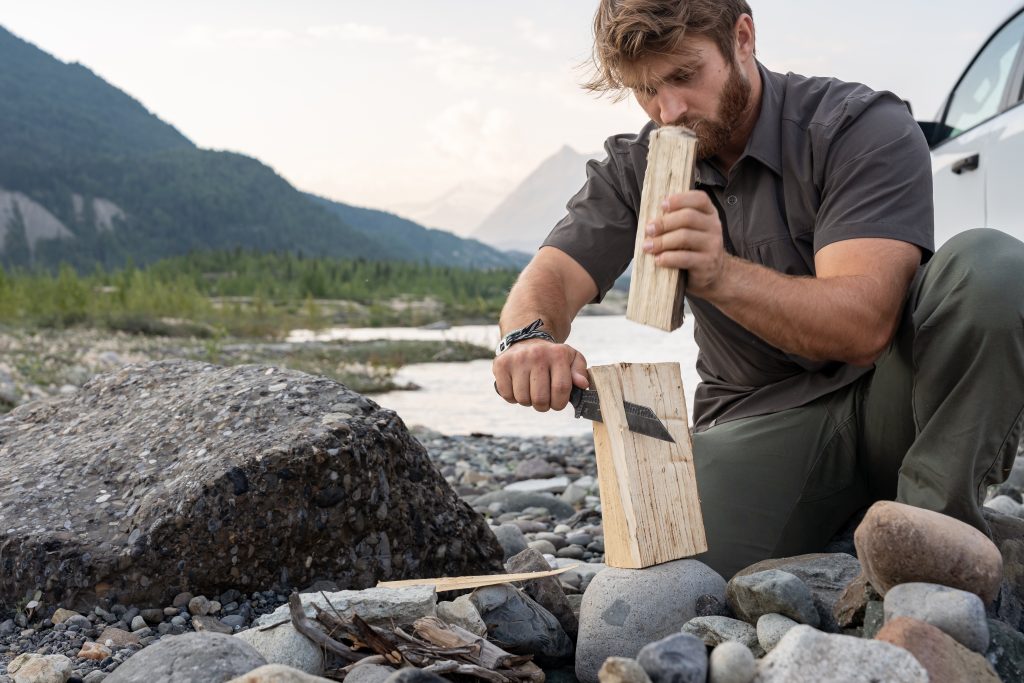
Feather sticks require edge consistency. Batoning requires blade strength and tang integrity. Food prep demands control and sharpness.
Cheap blades fail here. Welds crack. Edges chip. Handles loosen. This is why veteran-owned knives built in the USA emphasize full-tang construction, proven steels, and conservative designs that prioritize durability over gimmicks.
Stroup Knives exemplifies this approach. Their designs are not meant to be replaced—they are meant to endure.
Defensive Movement and Distance Management
Military knife skills do not teach aggression; they teach distance management. The blade creates space. It buys time. It enables escape.
Footwork, positioning, and awareness are more important than speed. The goal is not domination—it is survival.
Veteran-designed blades support this philosophy. Grip retention features, blade length choices, and ergonomics are all designed to reduce the chance of disarmament or loss of control.
Again, veteran-owned knives are not theoretical. They are built around how people actually move, stumble, and react under stress.
Maintenance Skills That Preserve Life
A dull or compromised blade is dangerous. Military knife skills include maintenance because neglect kills tools—and sometimes the people relying on them.
Knowing how to touch up an edge, prevent corrosion, and inspect for damage is part of responsible ownership. Veteran-owned knives are designed to be maintained, not discarded. Simpler finishes, accessible hardware, and robust materials support longevity.
A knife that cannot be trusted is worse than no knife at all.
Final Thoughts
Skill beats gear. But gear failure kills. Military knife skills only matter if the blade survives the moment of truth. That is why veteran-owned knives made in the USA are more than products—they are tools shaped by consequence.
Stroup Knives stands as an example of what happens when experience guides design. In the end, survival favors preparation, discipline, and tools built by those who understand what is at stake.