How to Read Knife Specs Before You Buy
A knife listing is five or six numbers and a word about steel. Most people skim them, buy on the photo, and find out afterwards that the knife is bigger than they pictured or thinner than they wanted.
Here is what each number is actually telling you.
Blade length
Measured from the tip to where the sharpened edge stops. This is the number that decides what the knife is good at.
Under 3 inches disappears in a pocket and handles everyday tasks. Opening boxes, cutting cord, food on the tailgate.
3 to 4 inches is the useful middle. Long enough to break down a deer, short enough to carry without thinking about it. If you want one knife for most things, it lives here.
4 to 5 inches gives you reach and more edge to work with. Better for long slicing cuts, skinning larger animals, and camp work where you want to cover ground with each stroke.
Over 5 inches is a chopping and batoning tool that also cuts.
Worth knowing: some states and cities set limits on carry length. Check yours before you buy something big to carry daily.
Overall length
Blade plus handle. Mostly it tells you whether the knife will fit your hand and your sheath carry position.
The useful thing to do with this number is subtract the blade length. What is left is the handle. Under 4 inches of handle gets cramped for a large hand in gloves. Around 4.5 to 5 inches fits most people with room to choke back.
A GP1 is 8.75 inches overall with a 4 inch blade, so 4.75 inches of handle. That is a full grip for a big hand.
Stock thickness
How thick the steel is at the spine, usually given in fractions of an inch or in millimetres.
This is the most underrated number on the list. It decides two things at once, and they pull against each other.
Thinner cuts better. A 1/8 inch blade slips through material. It is a better food knife, a better skinner, a better slicer.
Thicker takes more abuse. A 3/16 inch blade can be batoned through seasoned wood and pried with, within reason, without you holding your breath.
Our GP series runs 5/32 inch, which is the middle: enough spine for camp work, thin enough behind the edge to still cut properly. The TU series runs 3/16 for people who want the heavier tool.
If a listing does not give you stock thickness, that is worth noticing.
Hardness, the HRC number
Rockwell C scale. How hard the steel was taken during heat treat.
Under 56 is soft. Easy to sharpen, will not hold the edge long.
57 to 59 is the working range for a using knife. Holds a decent edge, sharpens on a stone, takes a knock without chipping.
60 and up holds an edge longer and gets progressively more brittle and harder to sharpen. Fine on a kitchen knife that lives on a board. Less fine on a knife that meets bone.
We run 58 to 59. A knife at that hardness goes back to shaving sharp on a pocket stone, which matters more in the field than another two hours of edge retention.
HRC on its own is not a quality signal. The same steel at the same hardness can be excellent or mediocre depending on how it was taken there. It is one number, not a verdict.
Grind
How the blade thins from spine to edge. Listings often skip it, which is a shame, because it changes feel more than almost anything else.
Flat grind goes straight from somewhere on the blade down to the edge. Predictable, good all-rounder.
Saber grind starts the bevel partway down, leaving a thick spine. Stronger, less slicey.
Convex is a rounded taper. Strong behind the edge and excellent at not binding in material, which is why it suits chopping and batoning.
Scandi is a single wide bevel that goes right to the edge. Bites into wood beautifully and sharpens by laying the whole bevel on a stone. Worse at food.
A thick knife with a good grind cuts better than a thin knife with a bad one. If you can only find out one thing beyond the numbers, find out this.
Handle material
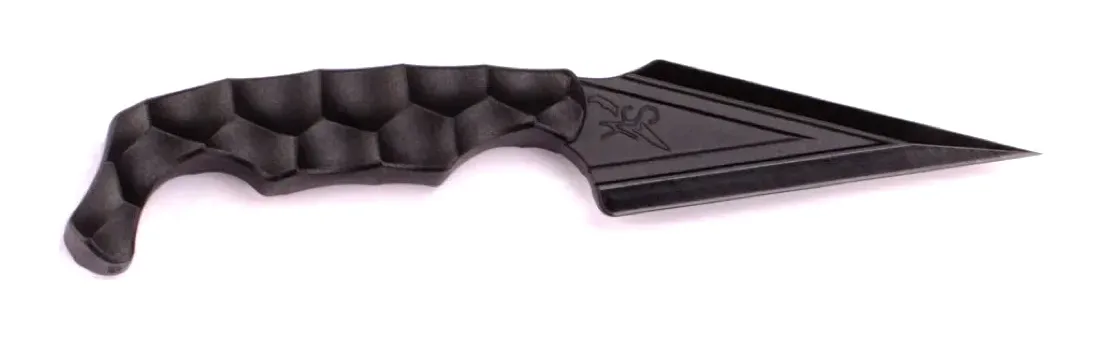
G10 is layered glass fibre in resin. Grippy when wet, does not move with humidity, and very hard to damage. The sensible default.
Stabilised and natural woods look better and feel warmer. They move a little with humidity and want occasional oil.
Micarta sits between the two. Linen or canvas in resin, grippier as it wears.
We offer G10 and Honduran rosewood. One is the tool answer, one is the thing you want to look at.
Sheath
Often an afterthought and should not be. A good knife in a bad sheath is a knife you leave at home.
Kydex is moulded plastic. Retains hard, draws clean, drains, and does not care about water. It is also noisy and will dull the edge slightly over hundreds of draws.
Leather is quiet and pleasant and absorbs water, which is exactly what you do not want against carbon steel.
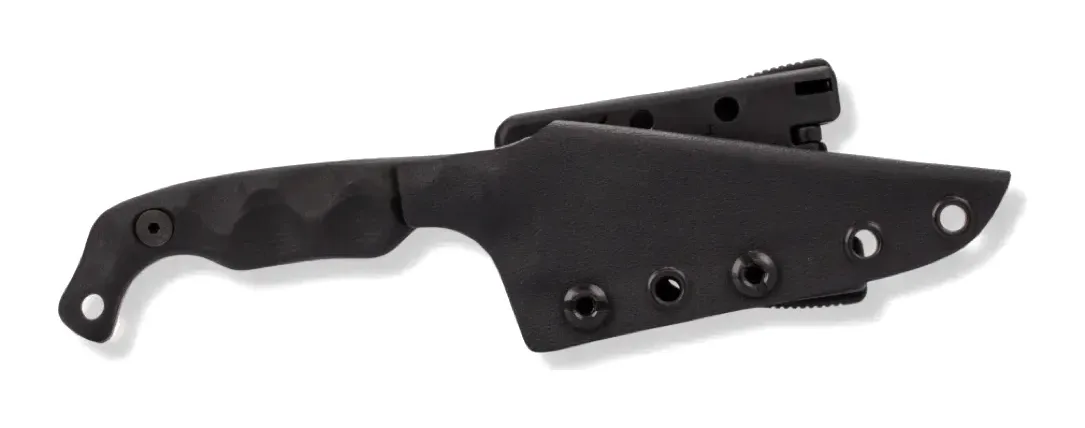
Our knives ship in Kydex with a Blade Tech Tech Lock belt clip, which means you can move it around a belt or a pack strap without tools.
Putting it together
Decide what the knife is for, then read the numbers in this order: blade length, stock thickness, grind, steel, hardness.
If you want one knife for hunting, fishing and camp, you are looking for roughly 3.5 to 4.5 inches of blade, 5/32 inch stock, a flat grind, a steel you can sharpen, and somewhere around 58 HRC.
That describes a lot of good knives, ours included.