How Issue Knife Design Shaped the Knives You Buy Today
The knives most people buy for hunting, fishing and camping owe more than they realise to knives designed under constraints that have nothing to do with the woods.
Not because of any romance about it. Because those knives were made for people who could not choose their conditions, could not pick their tasks, and could not look after the thing properly. Anything that survived that brief tends to be robust design.
Five ideas made the crossing.
Full tang construction
For a long time, a great many knives were built with a narrow rod of steel running into a stacked handle, held with a nut at the end. It is light, it is economical, and it is a hinge with a handle on it.
Issue knives moved to full tang construction, steel running the entire length and width of the handle, because knives kept failing at exactly that junction under shock load.
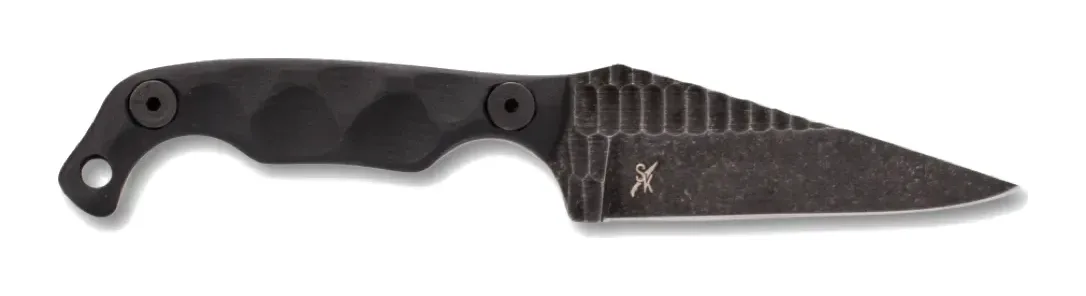
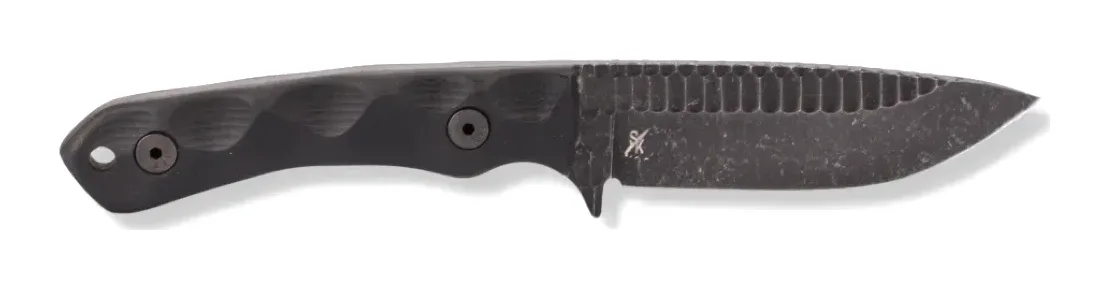
It is now the baseline expectation for any working fixed blade, and it is the single most reliable quality signal you can check by eye. If you can see steel along the top and bottom edges of the handle between the scales, the knife has a spine.
The drop point
The drop point is the most useful blade shape anyone has settled on, and its spread was driven by the same requirement that produced everything else: one knife, every job.
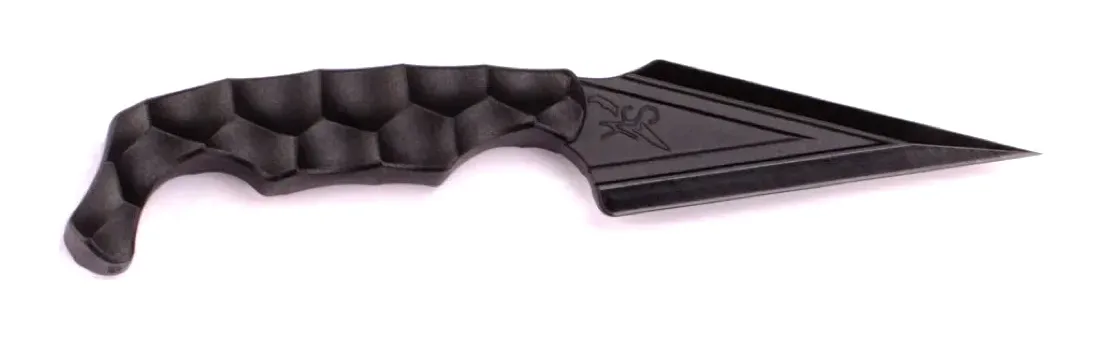
The tip sits below the line of the spine. That does three things at once. It makes the point stronger, because there is more material behind it. It stops the tip diving into whatever is under what you are cutting, which is why it took over hunting completely. And it leaves room for real belly, which is the curved section that does almost all of the work in a skinning cut.
Every one of our general purpose blades is some version of this idea.
Steel chosen for sharpening, not for specification
Simple carbon steels like 1095 were used at scale because they were economical and because they could be heat treated reliably in enormous quantities.
They stayed in use for a different reason: a blade you can bring back to sharp on whatever is to hand has a real advantage over one that needs a diamond plate and a jig. That advantage does not go away when better steels arrive. It is still true today, and it is why we use 1095 at 58 to 59 HRC rather than something harder with a longer spec sheet.
A sharp simple knife outcuts a dull exotic one, and the simple one is sharp more often.
Handle materials that ignore the weather
Wood and leather are lovely and they move. They swell, shrink, rot, and get slippery when wet, which is a nuisance on a Tuesday and a problem when you are a long way out.
G10, layered glass fibre in resin, came into general use through this lineage and is now on everything from fillet knives to chef's knives. It does not move with humidity, it holds grip when covered in fat and water, and short of a bench grinder it does not wear out.
We offer it alongside Honduran rosewood, which is the honest split: one is the tool answer and one is the thing you want to look at. Plenty of people buy the wood and they are not wrong, they just dry it.
Sheaths that retain and drain
Leather sheaths are quiet, handsome and absorbent, and absorbency is precisely the wrong property to have pressed against a carbon steel blade.
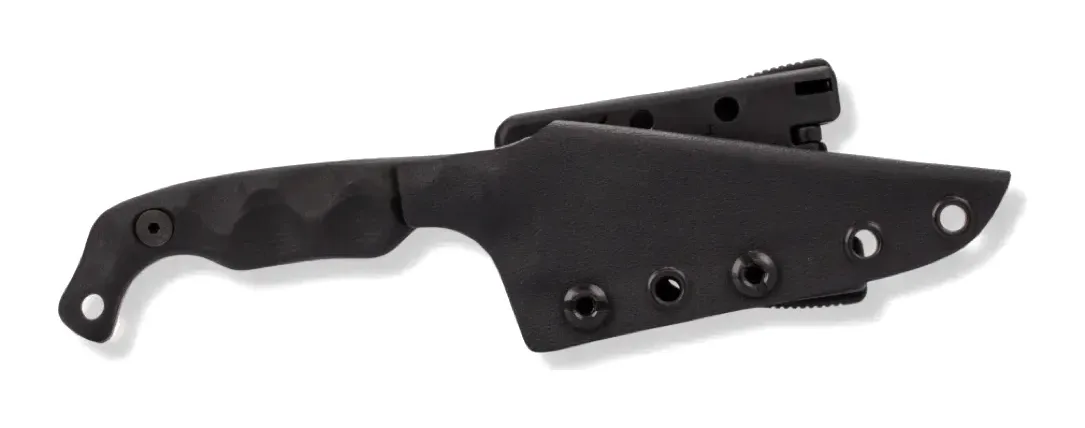
Moulded synthetic sheaths retain the knife mechanically, release it cleanly, drain, and do not care about water. Ours are Kydex with a Blade Tech Tech Lock clip, which means the knife can be moved around a belt, a pack strap or a waistband without tools.
The sheath is half the product and it is the half most people do not think about until the knife is living in a drawer because it never rode comfortably.
What did not survive
Worth noting, because it is instructive.
Hollow handles with a compartment, which put a void where the knife needs to be solid. Saw backs, which ruin a spine for batoning and saw badly anyway. Knuckle guards. Very long blades, which kept getting shorter every generation as it became clear that most work happens in the first four inches of edge.
The pattern is consistent. Anything specialised got dropped. Anything that made one knife better at everything stayed.
Where that leaves a knife made now
A four inch drop point, full tang, flat ground, simple carbon steel at a hardness you can sharpen, a synthetic handle that works wet, and a sheath you can position where you want it.
That is not a historical costume. It is what is left after a century of people finding out what breaks.
Reading knife specs covers what each of those numbers changes, and the comparison page shows the range side by side.